

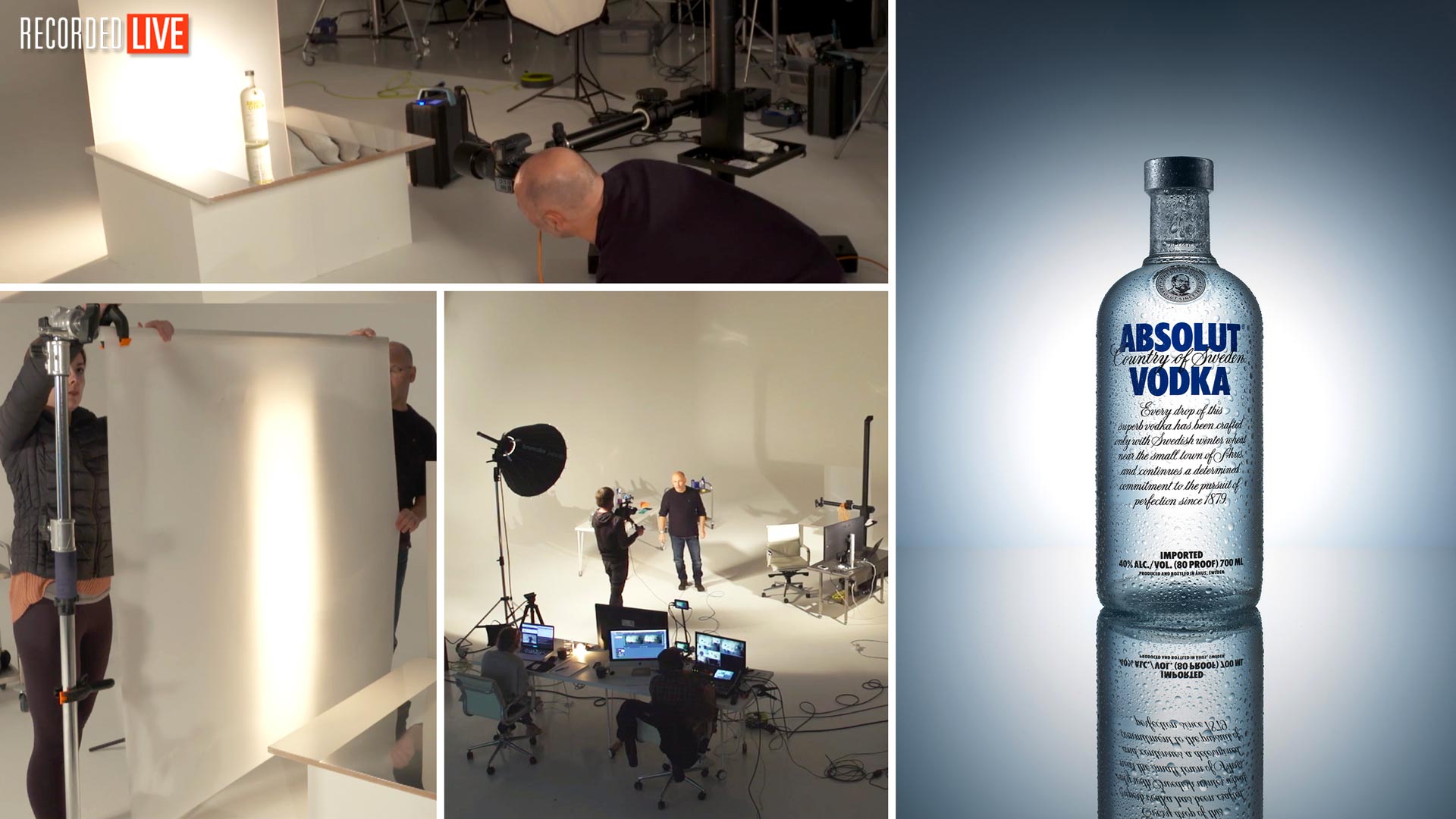

Photographing Clear Liquid Bottles (Gin/Vodka)
Wondering how to make bottles look beautiful? All will become clear…
Discover a host of clear bottle photography techniques that you can easily and effectively try out for yourself!
Learn from a pro as Karl shows you step-by-step how to light and photograph bottles of clear liquid such as gin or vodka.
You’ll discover how to achieve perfect condensation to create that cold, desirable look. Learn which backgrounds and base surfaces work best, and how to light the product beautifully using just two lights.
You’ll also learn how to incorporate additional lights to highlight the label and reduce unwanted shadows, further enhancing your shot.
Simple steps for photographing clear bottles:
- Prepare the bottle – This includes cleaning the bottle and creating controllable condensation
- Select the background and base surface – These will have a big impact on your overall image
- Light the product – This can be done using just a few lights with basic modifiers
- Photograph the bottle – Determine your composition and camera settings
If you enjoy this class, check out our Whisky Photography and Wine Bottle Photography classes. You can also find tips for creating your own perfect condensation in The Perfect Pint and Condensation Cold Look.
Questions? Please use the comments section below.
Comments
i have canon EOS R ,it has 30 megapixel with 24-105 L f4 , so this combo is good for product photography?
Hi, it will work at around the 80-105mm range but you may find that your lens doesn’t focus as close as you would like for small products.
For this bottle shot, what was the size of your opaque acrylic?
Hi, about 1.5m x 1m
Karl I am from Los Angeles and I called a plastic store to get a frosted plexiglas 5.5mil and its $110 for a small 3’x3′ is this normal ??
I cannot find a general plastic store where I can get plexiglass and golden cards, silver cards, would you mind giving me some store names if you know any please?
l
Hi, that seems expensive. 1m x 1m would cost me about $125, so you will need to find another supplier? For gold and silver card you need to look at art stores or art suppliers.
You can use water mixed with liquid glycerin.
Karl I have a hard time finding a metal sheet store in Los Angeles, it’s a huge town I am sure we have many but what do I look for I need these mirror sheets of steel you have and I need opaque acrylic 5mil sheets as well?
Hi, it’s polished stainless steel. Interior designers also use these sheets of metal but any metal fabrication shop will be able to source them. Acrylic is from plastic suppliers or sign manufacturing companies.
Hi Karl,
I am UK based and can’t seem to find the polished metal sheet on B&Q.
Do you still purchase it there? I’m not 100% sure how old this video is…
And where you do you purchase the frosted Acrylic from?
Thanks for all the great content.
Patrick
Hi Patrick, Try Barkston Plastics for your acrylic (may be under the Plastic People for small orders). B&Q stopped selling it but I now get it from my local metal workshop so if you find one in your area they should be able to order it.
Hi Karl, thanks for the information, and swift response.
What is the metal you order? Is it polished aluminium?
Cheers
Patrick
Hi Patrick, polished stainless steel, the thinner sheets are cheaper and it doesn’t matter how thin it is.
We all love teacher ashleigh !
Hi Karl,
I am looking to get into Product photography, it’s hard to judge the amount of space you have used in this setup.
– would I be able to realistically achieve anywhere near a “pro” like results in a small room of 13′ x 9′, would it be workable? I know it’s unfortunately far from ideal. You mentioned working in small spaces and by darkening the wall with a grey paint where possible.
– when considering lights, what would be the minimum light output you would reccomend ?
Thank you so much for sharing your valuable years of experience with us.
Hi, the smallest studio space I worked in was about 3.5m x 4.5m and I managed to produce good results in that. There are a lots of things you can do to help yourself such as black curtains to draw around the room perimeter and black foam board panels to velcro to your ceiling so you can choose a black or white ceiling as needed. The minimum amount of lights for product photography would be 4, possibly 3 if you were adept at moving lights and shooting another part of the product and then blending them together in post. Most modern cameras can handle 200 and 400ISO and still give you a very clean image, which means that 600J lights that would have been used at 100ISO become equivalent to 2400J lights if used at 400ISO. There’s usually ways to work around things but a good lens is crucial, you can’t be doing highly detailed product photography on a standard portrait, kit, or wide angle lens you need to be using a good Macro. As well as my medium format kit I’ve shot good product photography on Sony 35mm cameras with their dedicated 90mm Macro lens and you need a lens like that that is pin sharp and can also be used for focus stacking. In fact focus stacking, tethered shooting and software like Helicon become essential practises in product photography. I hope that helps but please watch more of the product section for further advice.
What is the diffusion material in front of the strip softbox? Lee 216?
Hi, yes.
hello,
what material is that for the background? where i can buy this?
Thanks
Hi, frosted acrylic sheet (it’s called plexiglass in the USA). It’s available from sign service companies or plastic suppliers.
Once you figure out all your lights intensity can you shoot one picture with all lights on to get your image or are you always obligated to merge multiple shots?
Hi, no this is all in one shot.
Where does the blue tone of this picture comes from??
Hi, it’s from the colour of the background acrylic.
👍
Hi Karl,
I’m gonna give this one a shot but I can’t find those frosted acrylic panels at similar size under the €100 mark.
Would it work if I use a combination of several layers (2 or 3 maybe) of diffusing paper right next to the other one ? Just wondering
Thanks
Hi
I have google a lot and looking after the sheet “polish stainless steel”. Can’t not found it. Do you have some link to the shop or have the “polish stainless steel” some other name?
Many thanks
Hi Karl,
Hope all’s well.
My back light through the matt frosted acrylic (5mm thick) is too bright on the lowest setting. Tried moving the light further back but then I lose the smaller circular glow. I’ve lowered the ISO to 64, but still bright. What else can I do?
Many thanks,
Mark
Hi, ND gels over the lights.
Thank you Karl. I’ll order some today and try those. I have a tricky gin glass shoot for a new client (they have a lot of product inventory so want/need to do a good job.
I’m slowly building up my resources as finances come in. But it’s going well. I started as a complete novice 18 months ago with your training alone. I’d never touched a camera previously. I now rent my own studio space (quite small but far better than my previous garage), and have about two clients every week. My website is (you can see it’s all 100% your training! haha! I hope I do you a bit of justice, please don’t cringe too much : )
http://www.markolivier.com
Thank you so much for all of your support.
Best wishes,
Mark
Hi looks good but try to get some more of your own original work on there as you may find clients will see my work and then see yours and guess where it’s come from. Also I remember seeing the shot of your red stilleto shoe in one of our challenges or competitions and thought it was very good so that shows you can come up with your own stuff. Your pricing seems ridiculously low but that entirely up to you to decide where you fit in the market. All the best Karl.
Thank you Karl.
Re: my pricing – because every project is a new one for me, with new challenges, I feel I’m still very much in a learning phase (apprentice), and NEED a much wider variety of experience. Once I’ve gained more experience, as I’m doing now every week, I’ll increase the prices. But appreciate you mentioning that.
I’ve just added two new slide shows to the front page of the website which are completely original – the waterproof bag shot in particular brought extra challenges trying to prep the bag to make it look good before a shot was taken. haha! You know the drill.
Oh, and I’m enjoying the lighting theory classes, feel like that helps reinforce things a lot.
Hope you keep producing those.
Again, many thanks, and say a big thank you to your team.
Best wishes,
Mark
Hey Karl how are you man? I just finished all the bottle shoot videos and I’m ready to start doing it myself but I got stuck with the basic thing of preparing the bottle. I’m in Brazil so I can’t find some products by the name in English the glucose it’s hard to find here so I’m thinking about replacing it with glycerin (if you tell me it’s ok of course). But the artist vanish I can’t even imagine what that is. Can you tell me what is the main use for it? Then maybe by the original use I can find it or find a replacement
Ok I can’t delete the comment lol. I will blame it on my bad English lol… It’s varnish and not vanish… but about the glycerin can be used instead of the glucose?
Hi, glycerin won’t work as it doesn’t set hard. You will find glucose or corn syrup in any shop that sells stuff for baking and making cakes. Artists varnish is used by artists for protecting their paintings so any good art store should have this.
Hi Karl,
Ciroc Vodka bottle have had problems with painted lettering on backside of the bottle. Would you please create a video using the Ciroc Vodka bottle and how best to remove the backside lettering and how to properly do the lighting.
My best result was bottle laying down on white board and low spot light shooting across it creating strong shadows with interesting blue shadow from the bottom of the bottle. Shot looked good but the letter on the back is a problem. Did use a knife, sandpaper, neither one removed the lettering.
Your classes are great.
Hi, can not scrape the letters on the back off with a scalpel and meth spirits?
Hi Karl, thanks for the informative lighting class for transparent products.
I am yet to finish looking at the the entire video, but curious about a few things like
1. Why was the surface on which the bottle is placed chosen to be so low?
(Isn’t it easy to shoot on a higher surface, approx waist height, so that you don’t have to bend down and struggle composing the shot looking into the camera. That is why the bottle must be tilted in the first attempt)
2. Wouldn’t composing this shot in the live mode of the Capture one software using the grid lines made this easier?
Hi Sanket and thank you. 1. Just so it makes it easier for our camera man to see the products and film. 2. Yes that would also work and is something you will see me use in other videos.
Hello, Karl! Thank you for your tutorials! They are really great! I have a question about background, I know that you mentioned the answer during webinar, but my English is not perfect and I didn’t catch it. So could you repeat it for me in a written form?
Why we use frosted acrylic for the back ground? Is it possible to use the same material for the background like for diffusers? I use for diffusers savage translum backdrop. What is the advantage of using frosted acrylic instead of savage film?
Hi Karl,
Thanks for this great video, I come up with a question, how or what is the best way to photograph a transperant cosmetic bottle which has been written on the front and the back of it ?
I tried to light it from the back as it’s trasperant but the photo shows all the writings from the back and front overlapping each other, so could you please help me ?
Thanks in advance.
I forgot to mention, there is no label; the texture is directly on the front and the back of the bottle,
Thanks in advance.
Hi R, It’s quite simple: you currently have writing on the back of the bottle and you don’t want it there. So you have to remove it with a sharp blade and methylated spirits. If it doesn’t remove then you have to insert something inside the bottle to disguise it. But if you are shooting this for the client then you ask them to provide you with a blank bottle for you to shoot that only has the writing on the front.
Hi Karl thank you for your great tutorials. I’ve got a question: If you had to decide to buy one thing: would you say you are more flexible with an acrylic mirror or would you buy a shiny black acryl plate? Best regards from Germany, Alex
Hi Alex, thank you. I’m afraid I don’t quite understand the question? Black gloss acrylic or Acrylic Mirror? To use for what, do you mean a base surface for products to sit on? If that’s what you mean then I photograph more things on gloss black than on a mirror but the acrylic mirror is also good for a reflector for other shoots.
Hi Karl, you are right. My question was not very specific. But you answered exactly what I wanted to know. Thank you very much!
Alex
Hi Karl
A 3mm white opaque acrylic glass would also be fine as a background ?????
Thanks
Aquilino
Hi, not if it is glossy as you may get reflections from this. As I was telling another members the frosted version is best as it is Matt finish.
Thanks Karl
Could you send me an example for reference, or a link where I can buy it?
Thanks in advance
Aquilino
Hi, I’m afraid I can’t other than you conatact a company similar to Barkston Plastics who can provide you with samples of the acrylic materials they manufacture or stock. Most sign service companies also hold sample ‘chips’ of various acrylics that can be ordered.
With the acrylic sheet the supplier has a couple of choices, they are clear frosted Acrylic or Opal Acrylic sheets which one is best ?
Hi, if it’s for the background then the frosted is better because it has a matt finish which reduces any chance of your lighting being reflected on it. If it’s for lighting a subject as a diffuser then I find the opal better.
Thank you for the reply, can I clarify, for the clear drink bottles with the perspex behind the bottle standing vertically with the light shining through, is frosted or opal better
Hi, the one behind the bottle is frosted which is better because it is matt and therefore it reduces reflections off of the surface back into your camera from your other lighting.
Hi
Is that gloss varnish spray?
Ta
Hi Stephen, I’ve used matt, lustre and gloss and I haven’t been able to notice a difference.
Hi there,
I’ve been looking for an acrylic sheet here in Germany like the one you use. I’ve found different porcentages of light transmissions and also different colors. Regarding these two things, what do you recomend?
Hi, I get asked this question a lot but I’m afraid I don’t know the transmission values of my acrylic as I have many different types and it never really seems relevant as I just increase or decrease my light source. I have 3mm and 5mm acrylics, some are white opal and some seem more transparent than others and I also have frosted acrylics in 3mm and 5mm and obviously the 3mm lets more light through than the 5mm. I simply adjust my lighting to suit as long as I get a ball of light then it’s good and I use the technique shown in these classes to make the corners a different exposure.
Hi Karl,
please could you help me choosing the right Plexiglas for this setup?
https://www.youtube.com/watch?v=sA7jgeUVK6I
I ordered samples and made this short comparison. Hope this may help some of you, too.
A (left) is “6mm PLEXIGLAS® WH10 DC weiss satiniert, Lichtdurchlässigkeit 70%”
B (right) is “8mm PLEXIGLAS® satiniert Milchglas”
I’d say it is the left one (A). 🙂
Thank you very much for your help!
best regards,
Jens
Hi Jens, yes definitely the one on the left as it has better diffusion.
Hi Karl, bit of advice if I may, you’ve shot clear bottles and also red wine bottles but nothing with white wine bottles which are green and a little see through, any tips and tricks? It’s a pack shot only so needs to be on a white background and perhaps a product shot on white background with a glass of bubbly next to it.
Hi Jason, this is something we’ve been asked about by several other members so I am going to include a new live show on that this year and add it to our schedule.
Could you use a $15 snoot for the label and mask out the excess light in Photoshop if you don’t have a $1500 picolight?
Hi, yes you can in fact in other classes we show using a snoot as an alternative, you can also be clever with your snoots by holding grids in front of them to further reduce the exposure area.
Why not to use glycerin and water 50:50 mixture?
Glycerin doesn’t set hard and is more difficult to work with.
Hello Karl
can i know How the background look blue without filter ?
My engineering curious mind is wondering if, there is an advantage to having a concave scrim. Would the wrap around light on the bottle be enhance ?
Hi, and your engineering mind would be exactly correct. You will see me solving certain problems with a similar thought process in these classes too:
https://visualeducation.com/class/jewellery-photography-rings/
https://visualeducation.com/class/shooting-shiny-chrome-objects/